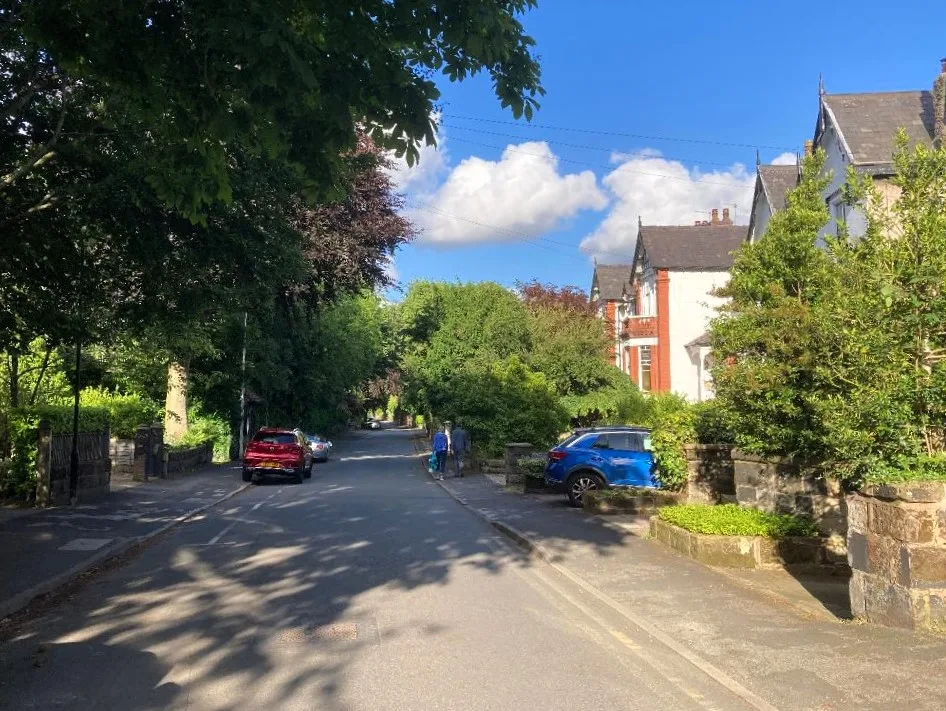

William Wood campaigned against child chimney sweeping from 1826 until his death. A blue plaque is now up at his Bowdon home, Willow Cottage, 28 Stamford Road.
A blue plaque has gone up on a house in Bowdon to a man most people in the village have never heard of. William Wood spent more than forty years trying to stop children being sent up chimneys, and he did most of it from Willow Cottage, 28 Stamford Road.
The plaque was unveiled on 11 August. Trafford Council’s Local Studies team organised the ceremony. Local residents, historians, the leader of the council, fellow executive members, Connor Rand MP and members of the Friends of Bowdon Churchyard attended (Trafford Council, 18 August 2026).
The man
Wood was born in 1782 and made his money as a wool merchant. According to the council’s account, his campaigning began in 1826, after he witnessed a boy fall to his death inside a soot-filled chimney onto a live fire.
What he then did for the next four decades was not conventional charity work:
- In 1828 he pushed for a mechanical chimney-cleaning system. Master sweeps resisted it on cost and on its design limitations.
- He put up placards at railway stations and wrote to newspapers to keep the issue in front of the public.
- He paid for prosecutions of master sweeps who broke the child labour laws out of his own pocket.
- He challenged magistrates directly, and challenged Queen Victoria over the use of a child sweep at Windsor Castle.
- He worked with Lord Shaftesbury, and gave evidence to the House of Lords in 1853.
He died in 1868, aged 85. Six chimney sweeps from five different towns carried his coffin to his grave in St Mary’s Churchyard, Bowdon.
What the law actually did, and when
The council’s release says the Chimney Sweepers Act of 1875 “finally banned the practice”. The Acts themselves tell a more specific story, and it is worth setting out, because it explains why a private citizen was still funding prosecutions in the 1850s and 1860s.
Sending a child up a chimney had already been unlawful for 35 years by the time Wood died:
- Chimney Sweepers and Chimneys Regulation Act 1840, royal assent 7 August 1840. It made it an offence to compel or knowingly allow anyone under 21 to ascend or descend a chimney, and stopped children under 16 being apprenticed to the trade (legislation.gov.uk).
- Chimney Sweepers Regulation Act 1864. It restated the under-21 prohibition and set a penalty of up to £10 (legislation.gov.uk).
- Chimney Sweepers Act 1875, royal assent 11 August 1875, in force from 1 January 1876 (legislation.gov.uk).
The 1875 Act did not introduce the ban. It introduced the thing the earlier Acts had lacked, which was somebody whose job it was to enforce them.
Under the 1875 Act, every master sweep had to hold an annual certificate issued by the chief officer of police, costing two shillings and sixpence, with the police keeping a register of them. Section 20 let a court strip a sweep of his certificate if he was convicted under the 1840 or 1864 Acts. Section 21 put the duty to enforce those two earlier Acts squarely on the chief officer of police.
That is why the trade changed after 1875 and had not changed after 1840. A sweep could now lose his livelihood, and the police, rather than a wool merchant in Bowdon paying his own legal bills, were the ones expected to bring the case.
The plaque was unveiled on 11 August, which is the date the 1875 Act received royal assent, 151 years earlier.
The law against the man
What it means for you
Bowdon has not had a blue plaque before, at least not one the council counts. Its published list runs to 36 plaques under six headings: Altrincham, Davyhulme, Old Trafford, Sale, Stretford and Urmston. There is no Bowdon section, and the list had not been updated to include Wood when we checked it on 20 August (Trafford Council: blue plaques in Trafford).
Anyone can put a name forward. The council takes nominations through an online Blue Plaque request form, and it says commemorations are usually only considered at least 20 years after the person’s death or the event.
Two places to see the story for yourself. The plaque is on Willow Cottage at 28 Stamford Road, on a residential street, so look from the pavement. The grave is in St Mary’s Churchyard, where the Friends of Bowdon Churchyard, who were at the unveiling, work on the burial ground.
Cllr Eve Parker, the council’s executive member for leisure, arts, culture and heritage, said Wood “fought tirelessly against unimaginable cruelty, using his own time and resources to protect vulnerable children across the country”.
There is more of this kind of thing in and around the town than most residents realise, and we keep the practical side of it on our things to do in Altrincham page.
Sources
- Trafford Council: Blue plaque unveiled in Bowdon for social reformer known as ‘The Climbing Boys’ Friend’, 18 August 2026 for the unveiling date and attendees, Wood’s biography, the funeral detail and the quoted comments.
- Chimney Sweepers and Chimneys Regulation Act 1840, legislation.gov.uk for the under-21 prohibition, the apprenticeship age and the 7 August 1840 royal assent.
- Chimney Sweepers Regulation Act 1864, legislation.gov.uk for the restated prohibition and the £10 penalty.
- Chimney Sweepers Act 1875, legislation.gov.uk for the 11 August 1875 royal assent, the 1 January 1876 commencement, the police certificate and its two shillings and sixpence fee, and sections 20 and 21 on deprivation of certificates and the police duty to enforce the earlier Acts.
- Trafford Council: blue plaques in Trafford for the published list of 36 plaques, the six place headings and the nomination rules.
Have your say