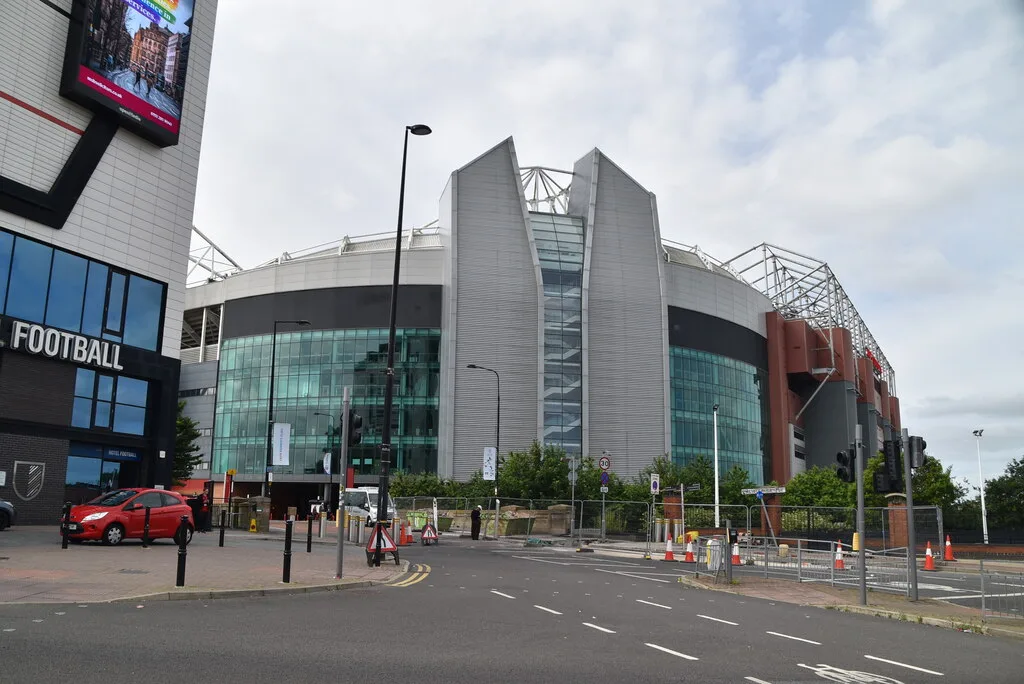

Trafford pays about £240,000 a year to clean up after Man Utd games and wants the club to contribute. Fly-tipping reports have nearly doubled since 2022.
Cleaning up after Manchester United games costs Trafford Council about £240,000 a year, and the club does not fund it. The council says most event organisers pay for this work, and that it is still trying to get a contribution from United.
The figure is in a report to the council’s Scrutiny Committee, which met on Wednesday 4 November. The same report shows a sharp rise in the mess residents are reporting across the borough, with fly-tipping the biggest part of it (Trafford Council: cleanliness of highways and greenspaces).
The report does not give the club’s response. The minutes of the meeting are not out yet, so we do not know what councillors said about it.
What the match-day operation covers
The report says the council’s cleansing teams also work at the Manchester Half Marathon and at Old Trafford Cricket Ground. Most of those events are paid for by the organiser, it says, “however this is not the case for Manchester United”.
For United games the work includes:
- extra large bins in busy areas and near food outlets
- bins at security points, so glass bottles can be taken off fans before the stadium
- sweeping the streets around the ground during the match
- a targeted clean within a three-mile radius on the morning after each match
- enforcement against traders who dispose of their waste wrongly
Fly-tipping reports: the numbers
Across all reported problems, the council’s log shows 4,985 requests between January and 13 October this year. That compares with 2,593 in 2022, a rise of 92%. The 2022 log only starts on 29 March, so the report is comparing about nine months of each year.
Fly-tipping makes up 1,808 of the 2,392 extra requests. Reports of full litter bins are up by 509 and graffiti by 75.
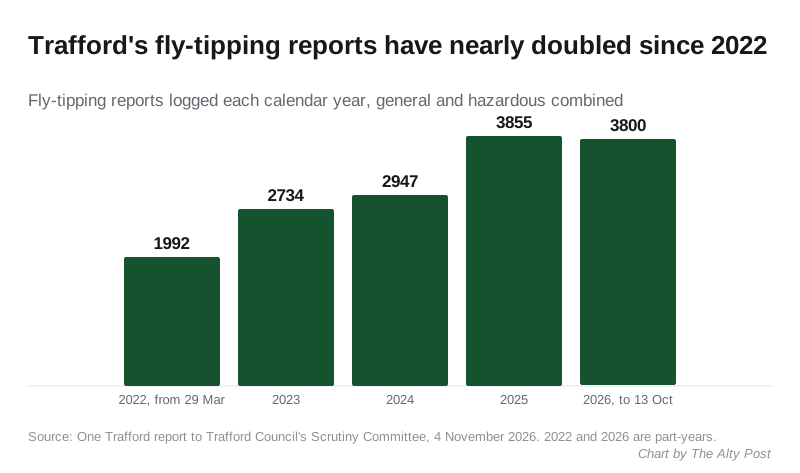
The fly-tipping reports by year are:
| Year | Reports |
|---|---|
| 2022, from 29 March | 1,992 |
| 2023 | 2,734 |
| 2024 | 2,947 |
| 2025 | 3,855 |
| 2026, to 13 October | 3,800 |
So this year was already within 55 reports of the whole of 2025 by mid-October. The weight collected is rising too: 213.40 tonnes in 2024-25 and 245.04 tonnes in 2025-26. It has reached 136.29 tonnes in the first half of 2026-27.
These are reports, not proven cases, and more people reporting would push them up as well. The report says national figures have risen in a similar way.
Trafford still does better than its neighbours. A table in the report puts it lowest in Greater Manchester, with 2,334 incidents, or 9.68 per 1,000 people. Salford has 25.85 per 1,000 and Manchester 25.38. The table’s year is printed as “2025/25”, and its count differs from the council’s own log. The report does not explain the difference.
Where it happens
The ten busiest postcode sectors are led by Old Trafford and Stretford. The chart in the report does not say which period it covers:
- M16 9: 2,396 reports
- M32 0: 1,866 reports
- M32 8: 1,028 reports
- M16 7: 782 reports
- M33 2, in Sale: 776 reports
- M16 0: 651 reports
- WA14 5, in Altrincham: 636 reports
- M32 9: 543 reports
- M33 4, in Sale: 515 reports
- M33 5, in Sale: 499 reports
WA14 5 and three Sale sectors are the only southern sectors in the top ten. The report says many Old Trafford cases are household rubbish left beside bins on residential streets and alleyways.
How often your street gets swept
Altrincham, Sale and Urmston town centres have bins emptied at least daily. The south of the borough gets much less on its side roads:
- Roads and pavements in the south and centre: two visits a year from the small sweepers
- Accessible main roads: every 12 weeks
- The A56 and other main routes into Trafford: every 14 days, on trial from this year’s leaf season
- Litter bins: on a repeating 14-day rota, about 1,300 across the borough
An extra large sweeper joins the leaf programme this month. The council collects about 1,600 tonnes of leaves a year.
Parked cars are a problem the report returns to more than once. If a car is parked over a drain or along the kerb, crews usually cannot come back for it.
What the council is doing about tipping
The report lists this year’s enforcement:
- 8 fixed penalty notices of £1,000 for fly-tipping
- 2 prosecutions in the magistrates’ court, with 5 more cases under review
- over 50 cases under investigation
- 21 movable cameras for alleys and rural spots
The fine is £1,000, or £400 if paid early. The report says the Government raised the maximum to £5,000 in September, and officers are considering a sliding scale.
Also in the report
- Garden waste charges brought in £1.932m in their first 10 months, £541,000 over target. This year’s forecast is £2.236m.
- The council cut highway weed spraying to once a year in 2024. Weeds grew back, so it trialled a second spray this year using AI to target individual weeds.
- The weedkiller glyphosate is approved in Great Britain until 15 December 2026, with a decision on extending that expected soon.
What it means for you
- Report tipping on the council’s website or through the One Trafford call centre. Hazardous or obstructive waste has a 24-hour removal target. General waste has 15 days, and has averaged 13 to 15.
- Getting rid of something big: the council’s bulky collection costs £44.10 for up to five items. The recycling centre is free for household waste.
- If you pay someone to clear rubbish, the council’s officers search dumped waste for evidence of where it came from, so check they are licensed.
The report’s figures are the council’s own. We will update this story when the meeting’s minutes are published. The council’s bin rounds are on our bin collection days page.
Have your say