
CQC scored Trafford's adult social care 56%, with 7 of 9 quality statements showing shortfalls. 455 people were waiting for occupational therapy in December, median wait 21.5 weeks.
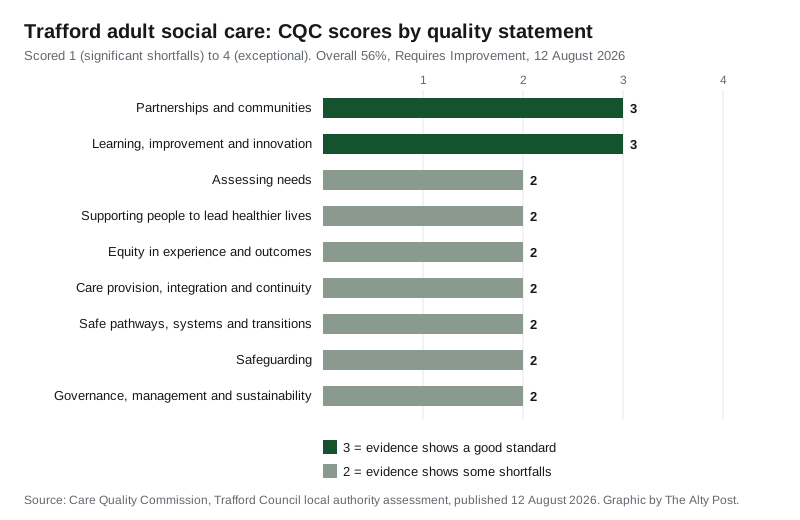
Trafford Council’s adult social care has been rated Requires Improvement by the Care Quality Commission, with an overall score of 56% and seven of the nine quality statements the regulator assesses marked as showing “some shortfalls”. The assessment was published on 12 August and covers the service that supported roughly 3,790 people with long-term care and 1,120 with short-term care in 2024/25.
The council says it “fully accepts the findings”, and points out that the assessment relates to a process that began more than a year ago, while its Improving Lives Every Day programme was already under way.
The scores
CQC scores each quality statement from 1 to 4. Trafford scored 2 (“evidence shows some shortfalls”) on assessing needs, supporting people to lead healthier lives, equity in experience and outcomes, care provision, safe pathways and transitions, safeguarding, and governance. It scored 3 (“evidence shows a good standard”) on two statements: partnerships and communities, and learning, improvement and innovation. Nothing scored 1 (significant shortfalls) and nothing scored 4 (exceptional).
What the inspectors found
The most concrete findings in the report are waiting times, and they cut both ways.
Care Act assessments have improved. In October 2025, the report says, 115 people were waiting for an assessment, with a median wait of 20 days and a maximum of 268 days; six had waited more than six months. By December 2025 that was 88 people, a median of 18 days and a maximum of 243 days, with four waiting more than six months. Financial assessments were quick: 24 people waiting in November 2025, median 7 days, maximum 15.
Reviews are the long tail. In October 2025, 513 people were waiting for a review of their care, with a median wait of 181 days and a maximum of 853 days. The most overdue reviews were in the learning disability team, which had 143 people waiting. Waits for reviews had come down by about 200 people over the previous year.
Occupational therapy is the sharpest problem. In December 2025, 455 people were waiting for an OT assessment, with a median wait of 21.5 weeks and a maximum of 55 weeks; five people had waited over 52 weeks. When the service’s transformation started in October 2025 there were 100 referrals that had not even been entered on the electronic system, and a locum occupational therapist was brought in. Inspectors also heard of waits for major adaptations through the disabled facilities grant that were “often over 12 months”. CQC said the OT team had “long waits and a lack of professional oversight from the local authority, which created risk to safety and reduced independence”.
Safeguarding: better on enquiries, a backlog on initial reviews. On 30 November 2025, 82 concerns were awaiting an initial review against a 28-day target, ten of them for longer than six months and the longest for 314 days. Once a concern became a Section 42 enquiry the picture was better: 80.4% were allocated within the seven-day target between November 2024 and October 2025, and the maximum wait for an enquiry was 29 days, down from 88 days in earlier data. The Deprivation of Liberty Safeguards waiting list fell from about 400 people in 2023 to 67 in October 2025.
Carers get the roughest deal in the report. CQC found unpaid carers’ assessments were “inconsistent” and lacked “parity of esteem” with the council’s own Care Act assessments; carers described “confusing pathways and a lack of support, especially in relation to respite care”. Carers’ assessments were held on a different system and were not considered when the person they care for was assessed. In December 2025, 91 carers were waiting for an assessment, which the commissioned carers’ organisation expected to clear within six to seven weeks. National survey data showed only a quarter of carers were happy with social services, below the England average, and the council had cut the funding of the organisation it commissions to carry out carers’ assessments.
Young people moving into adult services were, on average, not allocated to adult social care until they were 17.5, which CQC said left “limited time for young people to consider what care and support they would need in the future”.
The report is not one-sided. It describes “an inclusive and positive culture of continuous learning and improvement”, “a competent and passionate senior leadership team”, and “clear improvements” since a new interim Director of Adult Social Care was appointed in January 2025. The Improving Lives Every Day programme had begun with full case audits of 300 Care Act assessments, and staff told inspectors about a change in leadership and culture and “the increased sense of positivity within Adult Social Care services”.
The money
CQC’s own context section puts Trafford’s adult social care spend at £95,766,285 in 2024/25, up from £88,722,733 the year before and 22.33% of the council’s total spend. The council raised the full 2.0% adult social care precept for 2024/25. Trafford has 241,025 residents, of whom 17.6% are 65 or over.
What the council says has changed since
The council’s statement lists measures put in place since the inspection: mental health social care returned to direct council management; revised front-door arrangements with a new Adults Support and Prevention Hub due to launch in September; occupational therapy waiting lists reduced by 68% over nine months, with 99% of equipment delivered within seven days; a partner review of hospital discharge and a pilot at Wythenshawe Hospital; and shorter waits for carers’ assessments under the Trafford Carers Strategy. Those figures are the council’s, not CQC’s, and they post-date the assessment period.
Councillor Jane Slater, executive member for healthy and independent lives, said: “We welcome the clarity provided by this assessment and recognise the areas where further improvement is needed. We have already seen considerable progress over the past year, but we know there is more to do.” Council leader Councillor Tom Ross said: “We accept the findings of this assessment and are clear that improvement is required in some areas of Adult Social Care.”
What it means for you
- If you are waiting for an occupational therapy assessment or a home adaptation, the report confirms the waits are long and that the council knows it. CQC records that from mid-November 2025 the service was contacting everyone on the list who had not yet been screened, and planned a “waiting well” letter telling people who to contact if things change. If your circumstances worsen, tell the service; the list is being prioritised by need.
- If you are an unpaid carer, you are entitled to your own carer’s assessment under the Care Act, separately from the assessment of the person you look after. The report says some carers had to ask repeatedly. It also records that carers were more likely than the England average to have a support group or someone to talk to in confidence (48.35% against 32.98%), so ask what is available locally.
- If you have a care package, the review backlog means your annual review may be overdue. You can request one rather than waiting for it to be scheduled.
- The next assessment. CQC’s local authority assessments are a rolling programme; a Requires Improvement rating means the council will be expected to show progress against the areas identified. The full report, theme by theme, is on the CQC website.
Sources
- Care Quality Commission: Trafford Council local authority assessment, published 12 August 2026 for the rating, the 56% score, the nine quality statement scores, the demographic and financial context, and every waiting-time figure quoted above (overall summary; assessing needs; supporting people to live healthier lives; safeguarding).
- Trafford Council news, 12 August 2026: Care Quality Commission results published for Adult Social Care in Trafford for the council’s response, the post-inspection measures and the quotes from Councillors Slater and Ross.
Have your say